
CoverSense turns an ordinary manhole cover into a connected sensing node — delivering real-time safety and status intelligence across a city's underground network.
First scope: confined-space monitoring in drainage systems.
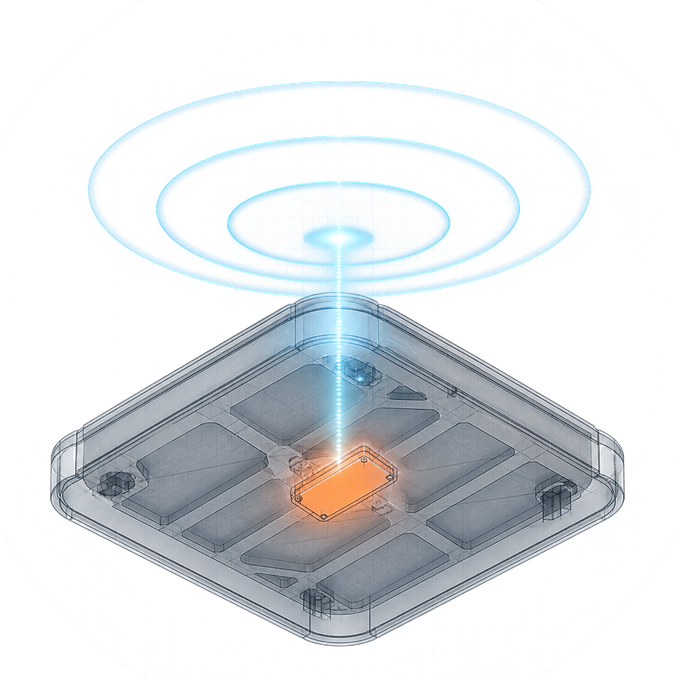
Beneath every street, drainage tunnels and utility vaults quietly keep the city running — key infrastructure that deserves careful monitoring and care. Yet these confined spaces are genuinely hard to watch: agencies have had few practical ways to know when a cover is opened, or what conditions lie beneath it. The need is clear and the care is warranted — but until now, the options to deliver that visibility have been limited.
Little visibility into what's actually happening below:
No reliable way to know when a cover is opened — by accident, or without a matching work permit.
Gas, oxygen and water levels inside the chamber stay unknown until someone climbs in to check.
Blockages, sediment build-up and changing water flow go unseen until they cause flooding or overflow.
CoverSense mounts to the underside of the manhole cover, using the void that already exists. Because the cover sits in the open, installation needs no confined-space entry, no drilling, and no modification to the manhole. Every cover becomes an intelligent node.
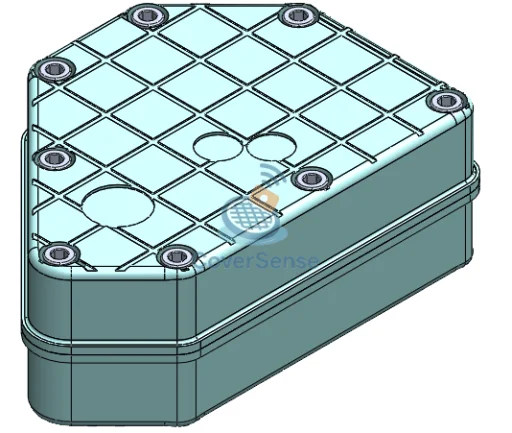
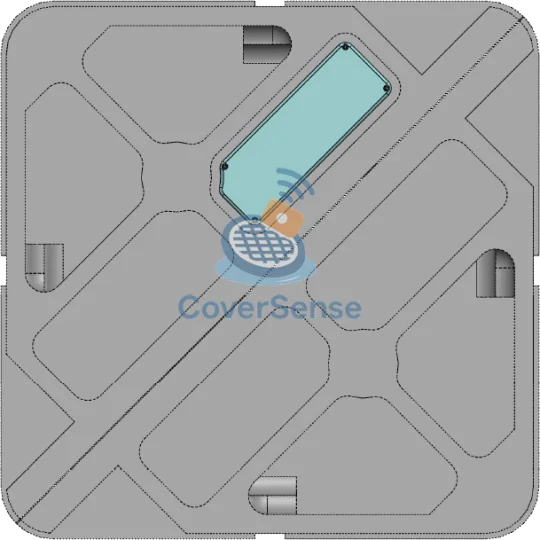
Competitors must open and re-engineer for the inside of every manhole — no two are alike. CoverSense designs to the cover and frame standard (e.g. DS1089, DS1034, DS1033), so every manhole using that standard is instantly compatible. Fit it at the factory for mass rollout, or glue it on-site in a rapid one-to-one cover swap.
A real Hong Kong drainage cover — retrofitted underneath, unchanged from the street, sensing from below, and streaming to a live dashboard. Six steps:
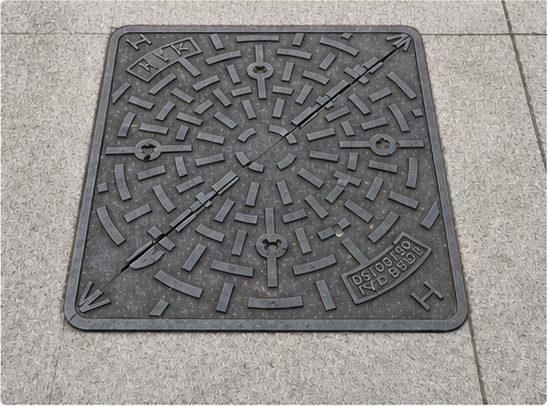
Start with a standard Hong Kong drainage cover, installed flush with the pavement.
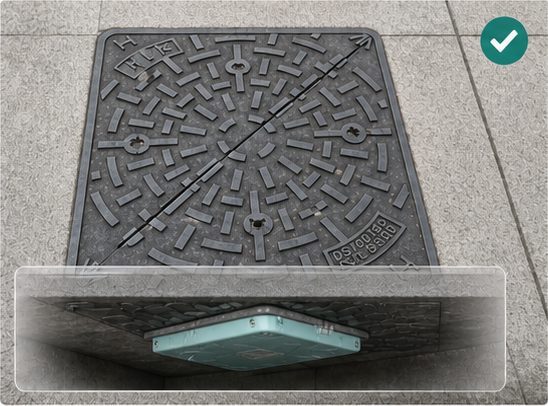
A compact CoverSense device mounts securely to the underside — no confined-space work.
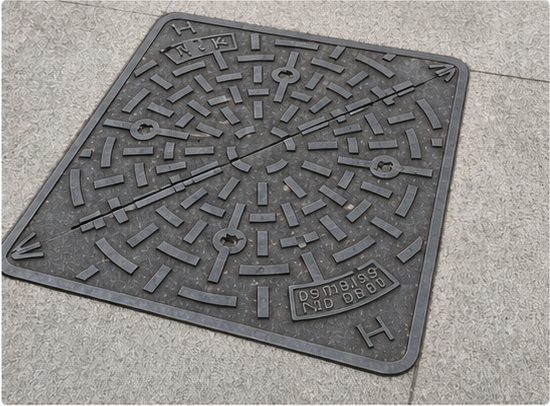
From above, the cover looks identical — no antenna, enclosure, cable or protrusion.
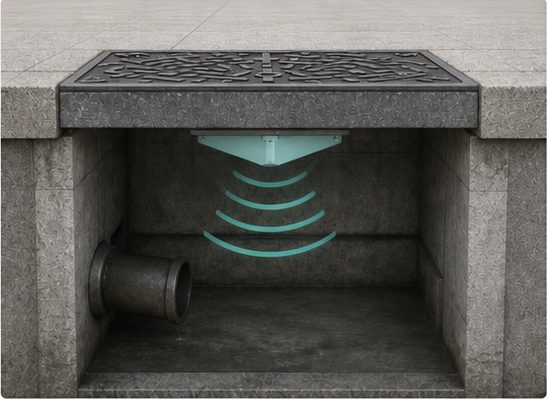
Sealed and closed, the device senses conditions inside the chamber and detects any access.
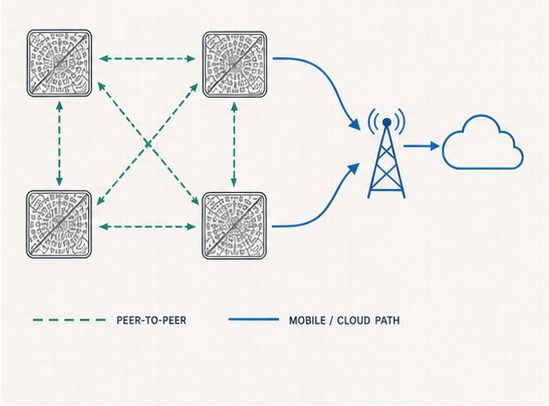
Devices mesh peer-to-peer and reach a secure cloud over the mobile network.
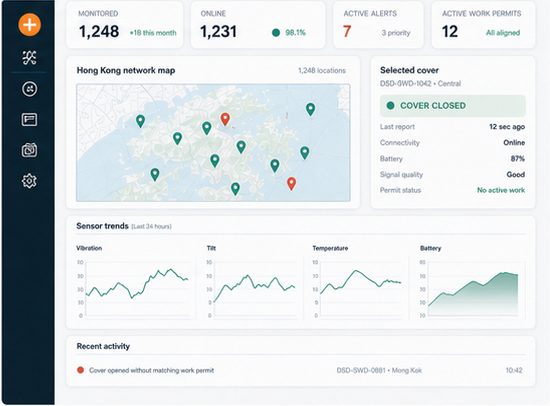
Readings, alerts, connectivity and battery surface on a real-time Hong Kong dashboard.
Each event is classified and routed the instant it happens — turning silent infrastructure into a real-time feed for the departments that need it.
Every reading a cover sends is training data. CoverSense turns a live network of covers into machine-learning models that don't just report what happened — they anticipate what's next, city-wide.
Learn each cover's normal rhythm and forecast blockages, corrosion and failures before they disrupt the street.
Fuse water-level and flow signals across the network to predict flooding and prioritise clearance where it matters most.
Spot abnormal gas, vibration or movement patterns the moment they emerge — catching risks a fixed threshold would miss.
Each cover becomes a data point in a living model of the underground, guiding smarter planning and faster emergency response.
Built on the founder's machine-learning background — bringing AI capability to Smart-City infrastructure from day one.
The entire industry installs sensors inside the manhole. That single choice makes their approach slow, costly and dangerous. CoverSense changes where the sensor lives.
The invention and its physical designs are granted, ownable intellectual property — a firm basis for licensing, joint ventures and confident partnership.
The core invention protecting the CoverSense system — granted and in force.
✓ GrantedRegistered industrial designs protecting the physical form of the CoverSense device.
✓ GrantedFurther patent applications filed and progressing through examination.
◷ PendingAnd that figure excludes water, power, transport and private utilities. The same standardised, retrofit-ready approach travels to Singapore, the Middle East and any city whose covers follow a standard — a template that scales far beyond one market. B2G and B2B by design; never consumer.
A deliberate first wedge with a clear buyer and an urgent problem — expanding into a full Smart-City sensing layer on the same standardised hardware.
Cover access & removal detection, permit-to-work alignment, and the sensing groundwork for hazardous-gas and flood risk — where the safety stakes, regulation and fatalities make the need undeniable.

Hin Lam is the inventor and owner of the CoverSense technology. He has spent over a decade across Cloud Computing, machine learning, global logistics and cloud-native software at leading technology companies — from infrastructure to multi-cloud platforms.
He is among a small number of Google TensorFlow–certified engineers in the region, and brings that AI capability directly to CoverSense's Smart-City data — turning a network of covers into predictive intelligence for the whole city.
We're raising to take CoverSense from granted patent to city-scale deployment — starting in Hong Kong's drainage network. If you back infrastructure, IoT and Smart-City platforms, let's talk.
We've received it and will reply by email shortly.